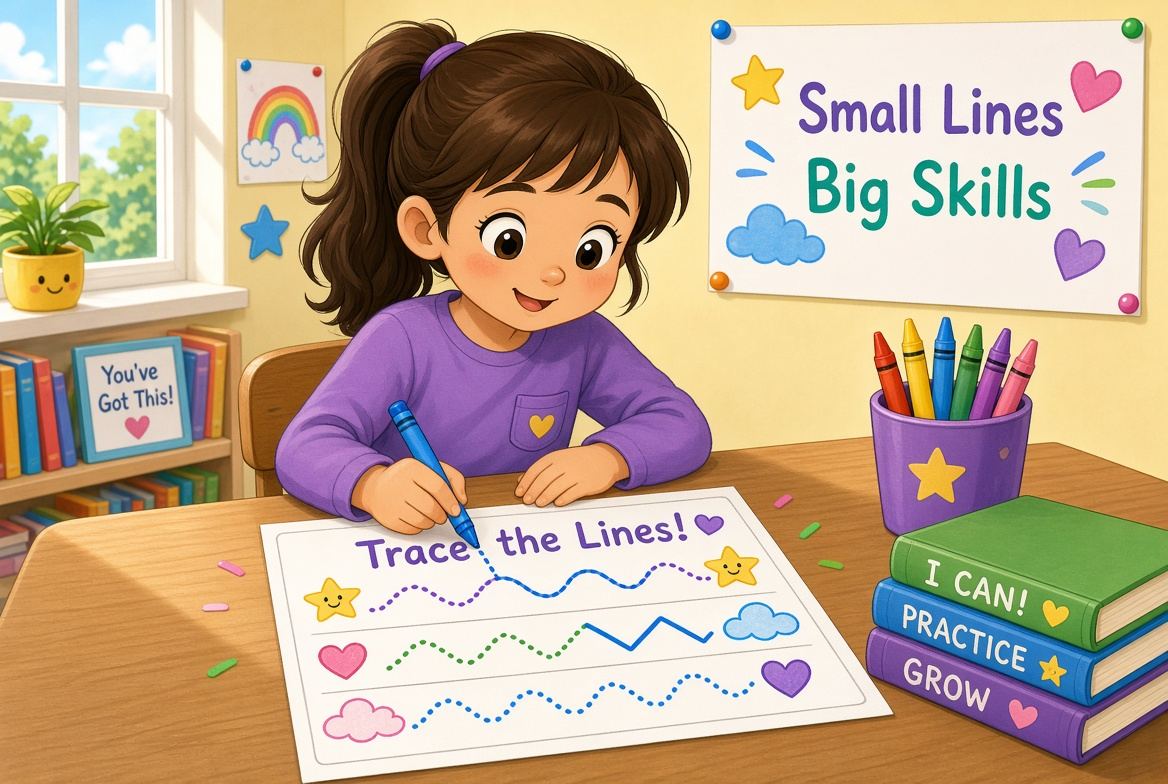
What does prewriting mean?
Prewriting includes playful activities that let children explore marks, shapes, hand movements, and the relationship between what they see and what they draw.
The goal is not perfect lines. It is to offer enjoyable opportunities to practise coordination and confidence.
Five playful prewriting activities
Drive the road: draw a wide road with straight, curved, and zigzag sections. Let a toy car travel along it.
Draw in the air: use a finger to make large lines and circles.
Trace with a finger: follow a large circle or wavy line before trying a crayon.
Make a sticker trail: connect suitable large stickers with a drawn line.
Build a picture from shapes: make a house or robot from simple shapes and let your child add details.
Which marks can children explore?
- Vertical and horizontal lines.
- Circles and loops.
- Wavy lines and zigzags.
- Simple paths and corners.
- Shapes that combine straight lines and curves.
Support without pressure
- Keep activities short and stop when your child is ready.
- Offer a comfortable writing surface and suitable tools.
- Let your child choose colours and subjects.
- Praise exploration instead of neatness alone.
- Include building, play dough, and other hands-on activities.
When should children start writing letters?
Children vary in when they are ready for formal handwriting practice. Follow guidance from your child's teacher or early-years setting and focus on comfort and gradual progress.
If writing or hand movements cause persistent pain or significant difficulty, ask an appropriate professional for advice.
Keep learning through play
Find printable activities for drawing, tracing, and creative practice.
Browse Worksheets