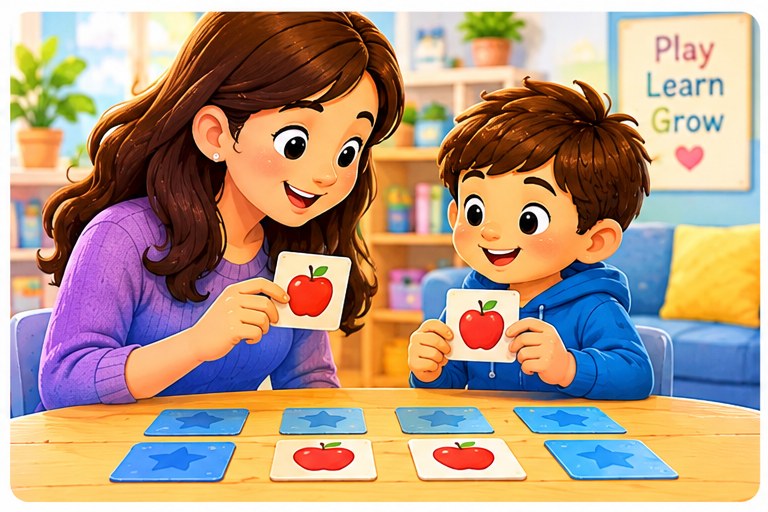
What memory games help with
Simple remembering games support attention, listening, and the ability to hold information in mind for a short time.
They can be played anywhere — while waiting, walking, or during quiet moments at home.
Five memory games to try
- Kim's game: place four small objects on a tray, cover them, and ask your child to name as many as they remember.
- Sound sequence: clap, tap, stamp, and ask your child to copy the pattern.
- Shopping list: take turns adding one item to an imaginary shopping list and repeating all the items.
- What changed: show three objects, cover them, remove one, and ask which is missing.
- Picture story: look at a picture together, then turn it over and describe what you saw.
Play without pressure
Memory games work best when there is no timer and no score. Offer hints and let your child try again.
Celebrate effort rather than speed, and stop before your child becomes tired or frustrated.
Adapt for different ages
For younger children, use fewer objects or shorter sequences.
For older children, add more items or ask them to remember the order as well as the names.