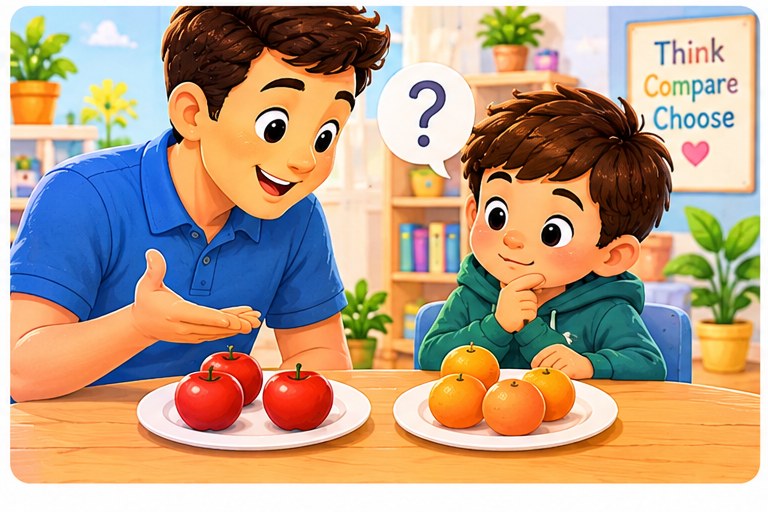
Reasoning happens in everyday moments
Children practise reasoning when they compare two things, make a choice, or explain why they picked one option over another.
You do not need special materials. Daily routines such as getting dressed, preparing food, or tidying up offer many chances to talk through choices.
Five reasoning games to try
- This or that: offer two snacks and ask your child to choose one and say why.
- Odd one out: show three objects where two belong together and ask which is different.
- Size line-up: gather toys or shoes and arrange them from smallest to biggest.
- What comes next: during a routine, ask what step comes after putting on socks.
- Same and different: compare two leaves, two socks, or two toys and talk about how they are alike and not alike.
Encourage explanations
When your child makes a choice, ask an open question such as “Why did you pick that one?” or “How do you know?”.
Listen carefully and repeat back part of their answer to show you are listening.
There is no need to correct every answer. The goal is to practise explaining thinking, not to get it right every time.
When answers are mixed up
If your child is unsure, offer two clear choices instead of an open question.
Model your own thinking out loud: “I think we should put the spoon here because it is near the bowl.”
Keep the tone playful and stop when your child is ready to move on.
Keep learning through play
Practise matching, sorting, and picture puzzles with PuzzlePath.
Explore Logic Lab